California community action
The aim of this page is to recognise, celebrate and encourage the self-empowerment of community agency networks (CANs) and community groups' activism for climate, environment and many other sustainability topics across California. The majority of our information about this is collated via our place pages...Near you. Most of this page focuses on California community action topics. California community resources and Ecological restoration California are separate pages.
News
 Strengthening The Connective Tissue Of Democracy, noemamag.com (Feb 27, 2025)
 - Green Microgrids Are Powering a More Resilient Future, reasonstobecheerful.world (Jan 17, 2025)
- The ‘convoy of incredible people’ saving animals from California’s infernal fires, theguardian.com (Jan 14, 2025)
- How to find climate data and science the Trump administration doesn’t want you to see, theconversation.com (Feb 14, 2025)
- Do US states with more renewable energy have more expensive electricity? Hannah Ritchie, sustainabilitybynumbers.com (Feb 11, 2025) — Despite California being the poster child of high prices, the data suggests no
- More Solar and Battery Storage Were Added to Texas’ Grid Than Any Other Power Source Last Year, insideclimatenews.org (Feb 10, 2025)
- ‘Global weirding’: climate whiplash hitting world’s biggest cities, study reveals, theguardian.com (Mar 12, 2025)
- Only seven countries worldwide meet WHO dirty air guidelines, study shows, theguardian.com (Mar 11, 2025) — Governments could clean their air with policies such as funding renewable energy projects and public transport; building infrastructure to encourage walking and cycling; and banning people from burning farm waste.
- Many cities are banning ads for airlines, SUVs and fossil fuels – and yours could be next, theconversation.com (Mar 10, 2025)
Video
Community involvement
Networks and sustainability initiatives
- Eco Vista Community, Taking The Community Of Isla Vista Into The Future added 09:02, 25 April 2020 (UTC)
- NorCal Community Resilience Network, "...activates and supports community-based and ecological solutions to climate change, economic instability and social inequity toward a Just Transition away from fossil fuels. Our vision is to transform our homes, neighborhoods and communities into self-sufficient, regenerative places." NorCal Resilience Network on facebook
- Communities for Sustainable Monterey County, A Transition Initiative
- A Place for Sustainable Living, Oakland
- Sustainable Fairfax
- Transition United States, listing of official (local) initiatives
- Transition Joshua Tree
- Transition Pasadena
- University of California, Santa Cruz, Office of Sustainability, UCSC Education for Sustainable Living Program
- UC Santa Barbara Environmental Affairs Board
Bioregionalism
- Regenerate Cascadia, 501(c)3 social movement organization developing a long-term bioregional vision and process that works with on-the-ground communities to design and implement new frameworks of governance, ecology, and economy for the regeneration and health of the Cascadia bioregion along the northeast Pacific rim of North America and beyond.
- Bay Delta Trust, "a convening and weaving initiative seeking to improve bioregional coordination in the San Francisco Bay and Sacramento-San Joaquin River Delta." added 14:51, 14 May 2024 (UTC)
Localism
Fibershed, Local fibres, local dyes, local labor - Willits Economic Localization
Climate action

CoolCalifornia.org is a website for Californians with resources to help them reduce their impact on the environment and combat climate change. The website is geared towards different audiences, including: individuals, small businesses, local government, youth, community organizations, and schools. The website currently features two carbon footprint calculators. One is for individuals and households and one is for small businesses; a similar tool for local governments is under development.
California has taken a number of legislative steps and extensive measures and initiatives targeted at the broader issue of climate effects seeking to prevent and minimize the risks of possible effects of climate change by a wide variety of incentives, measures and comprehensive plans for clean cars, renewable energy, and pollution controls on industry with overall high environmental standards. California is known for its leading role in the realm of ecoconscious legislature not just on a national level but also globally.
In 2007, the California Legislature enacted AB 32, the Global Warming Solutions Act of 2006, which required the state to reduce greenhouse-gas emissions to 1990 levels by 2020. It tasked the California Air Resources Board (CARB) with developing a Scoping Plan to implement the statute. AB 32 was consistent with Governor Arnold Schwartznegger's 2005 Executive Order S-03-05, which, in addition, required California to reduce its emissions to 80% below 1990 levels by 2050. CARB updated the Scoping Plan in 2014. SB 32, enacted in 2016, set the State's climate goals beyond 2020, requiring a 40% reduction below 1990 levels by 2030 and an 80% reduction by 2050. The CARB 2017 Scoping Plan, detailing how the State will implement SB 32, sets statewide goals for per-capita GHG emissions: they must be reduced to 6 MTCO2e (metric tonnes of carbon-dioxide equivalent) by 2030, and 2 MTCO2e by 2050. CARB's 2022 Scoping Plan continues the implementation of SB 32.
Sustainable transport activism
High Speed Rail: The California High-Speed Rail Authority was created in 1996 by the state to implement an extensive 700 mile (1127 km) rail system. It would provide a TGV-style high-speed link between the state's four major metropolitan areas, and would allow travel between Los Angeles' Union Station and the San Francisco Transbay Terminal in two and a half hours. Voters approved Proposition 1A in November 2008, approving a $9 billion state bond to finance the project. Then in 2012, the California legislature and Governor Jerry Brown approved construction financing for an initial stage of the project. However, the High Speed Rail Authority still estimates that the initial stages will not be completed until 2021.
Plug-in electric vehicles in California
The stock of plug-in electric vehicles in California is the largest in the United States, and as of December 2023, cumulative plug-in car registrations in the state since 2010 totaled 1.77 million units. Between November 2016 and until 2020, China was the only country market that exceeded California in terms of cumulative plug-in electric car sales.
Hiking trails: Wikipedia:Category:Hiking trails in California (category)
Cycling activism
- California Bicycle Coalition
- Davis Bicycles!, 501(c)(3) nonprofit citizen group dedicated to promoting bicycling in Davis, California
- Wikipedia: Bike paths in California (category), Bike paths in Orange County, California (category)
Urban sustainability
Ecological restoration

This page is the beginnings of a portal for California community action in response to Ecological emergency. The majority of our information about this is collated via our place pages ...Near you.
About California
Campaigns
Californians Against Fracking on facebook
Past events
- May 3, 2014, Pasadena Earth & Arts Festival
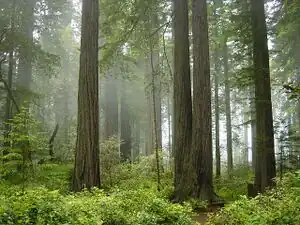
California is known for its relatively progressive policies on sustainability and support of renewable energy, as well as its natural beauty, including redwood forests.
California () is a state in the Western region of the United States that lies on the Pacific Coast. It borders Oregon to the north and Nevada and Arizona to the east, and shares an international border with the Mexican state of Baja California to the south. With over 39 million residents across an area of 163,696 square miles (423,970 km2), it is the most populous U.S. state, the third-largest by area, and the most populated subnational entity in North America.
Prior to European colonization, California was one of the most culturally and linguistically diverse areas in pre-Columbian North America. European exploration in the 16th and 17th centuries led to the colonization by the Spanish Empire. The area became a part of Mexico in 1821, following its successful war for independence, but was ceded to the United States in 1848 after the Mexican–American War. The California gold rush started in 1848 and led to social and demographic changes, including depopulation of Indigenous tribes.The western portion of Alta California was then organized and admitted as the 31st state in 1850, as a free state, following the Compromise of 1850.
Near you
Los Angeles - Long Beach - San Diego - San Francisco
External links
- Ecology of California, Environment of California, Water in California, Environmental issues in California (category)
- Environment California (Wikipedia, Criticism)
- Sustainability, information from the City of Ventura