Degrowth
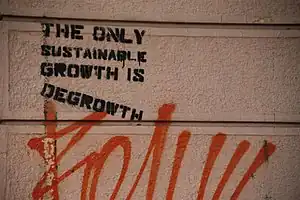

Degrowth is an academic and social movement critical of the concept of growth in gross domestic product as a measure of human and economic development. The idea of degrowth is based on ideas and research from economic anthropology, ecological economics, environmental sciences, and development studies. It argues that modern capitalism's unitary focus on growth causes widespread ecological damage and is unnecessary for the further increase of human living standards. Degrowth theory has been met with both academic acclaim and considerable criticism.
Degrowth's main argument is that an infinite expansion of the economy is fundamentally contradictory to the finiteness of material resources on Earth. It argues that economic growth measured by GDP should be abandoned as a policy objective. Policy should instead focus on economic and social metrics such as life expectancy, health, education, housing, and ecologically sustainable work as indicators of both ecosystems and human well-being. Degrowth theorists posit that this would increase human living standards and ecological preservation even as GDP growth slows.
Degrowth theory is highly critical of free market capitalism, and it highlights the importance of extensive public services, care work, self-organization, commons, relational goods, community, and work sharing.Degrowth theory partly orients itself as a critique of green capitalism or as a radical alternative to the market-based, sustainable development goal (SDG) model of addressing ecological overshoot and environmental collapse.
Critiques
Growth not necessarily harmful
A key criticism of degrowth is that economic growth itself is not the thing that causes harm. In many ways it causes benefits, including in creating resources for environmental protection.
The harmful effects of growth are not universally or irrevocably tied to growth. Economic growth from the installation of solar panels, the provision of human services such as therapy or the renting of bicycles each differs fundamentally from economic growth that derives from air travel, fossil fuel production or ocean trawling.
Where specific environmental impacts have been untied from economic growth, great improvement has been possible without degrowth. Examples include acid rain, ozone depletion, and (in limited cases so far) decarbonization of energy systems.
Response:
Degrowth advocates usually accept that decoupling is possible, eventually. But it is not coming fast enough to bring carbon emissions under control.
Political
Another common critique is political infeasibility. There are no popular political parties with a strong degrowth agenda.
See also
- Global Degrowth Day
- Towards sustainable economies #Degrowth
External links
- The Post Growth Institute
- Can we save the planet by shrinking the economy?, Kelsey Piper, Vox, 2021: The “degrowth” movement to fight the climate crisis offers a romantic, utopian vision. But it’s not a policy agenda.