New York City community action
The aim of this page is to recognise, celebrate and encourage the self-empowerment of community agency networks (CANs) and community groups' activism for climate, environment and many other sustainability topics across New York City. It's an introduction to local networks, groups, and events. NYC community resources is a separate page.
News
 New York first US city to have congestion charge, BBC News (Jan 05, 2025)
 - From Asphalt to Inspiration: The Student-Led Transformation of America’s Schoolyards, reasonstobecheerful.world (Oct 04, 2024)
- The Towns Outsmarting Airbnb, reasonstobecheerful.world (Apr 02, 2024)
- How to find climate data and science the Trump administration doesn’t want you to see, theconversation.com (Feb 14, 2025)
- Do US states with more renewable energy have more expensive electricity? Hannah Ritchie, sustainabilitybynumbers.com (Feb 11, 2025) — Despite California being the poster child of high prices, the data suggests no
- More Solar and Battery Storage Were Added to Texas’ Grid Than Any Other Power Source Last Year, insideclimatenews.org (Feb 10, 2025)
- ‘Global weirding’: climate whiplash hitting world’s biggest cities, study reveals, theguardian.com (Mar 12, 2025)
- Only seven countries worldwide meet WHO dirty air guidelines, study shows, theguardian.com (Mar 11, 2025) — Governments could clean their air with policies such as funding renewable energy projects and public transport; building infrastructure to encourage walking and cycling; and banning people from burning farm waste.
- Many cities are banning ads for airlines, SUVs and fossil fuels – and yours could be next, theconversation.com (Mar 10, 2025)
Video

Networks and sustainability initiatives
- Sustainable South Bronx
- Change by Us NYC
- planyc, is an effort released by New York City Mayor Michael Bloomberg in 2007 to prepare the city for one million more residents, strengthen the economy, combat climate change, and enhance the quality of life for all New Yorkers. The Plan brought together over 25 City agencies to work toward the vision of a greener, greater New York. Since then, significant progress has been made towards the long-term goals set by the Plan.
- PlaNYC specifically targets ten areas of interest: Housing and Neighborhoods; Parks and Public Spaces; Brownfields; Waterways; Water Supply; Transportation; Energy; Air Quality; Solid Waste; and Climate Change.
- Over 97% of the 127 initiatives in PlaNYC were launched within one-year of its release and almost two-thirds of its 2009 milestones were achieved or mostly achieved. The plan was updated in 2011 and has been expanded to 132 initiatives and more than 400 specific milestones for December 31, 2013. (Wikipedia), GreeNYC
Each week 3 different short videos from across the world.
Spain community action, Sweden community action, Canada community action / ...This week's UK videos
Ecovillages
- Ganas, "community started on Staten Island in 1979. The original founders came together to form a self-selected extended family based on an intention to care for each other while sharing the work, having fun and addressing whatever problems arise, together. Open minds make it possible to talk together and understand each other better. Ongoingly, they are learning how to cooperate, care for each other and share resources."
Community involvement
- BetaNYC, building a better tomorrow for all. "We are NYC's civic technology and open government vanguard. Since 2009, we have been leading elected officials to engage NYC's technology community, helping pass transformative open government legislation, and supporting NYC's civic oriented startups. We are America's largest civic technology and open government community."
- Participatory Budgeting in New York City
Climate action
- Climate Families NYC, "Family-led activism for a better future", added 17:03, 21 December 2023 (UTC)
Climate change mitigation
The NYC Mayor's Office Climate Policy and Programs team, who also manages the OneNYC program, said in 2018 that it is pledging to reduce greenhouse gas emissions by 80% by the year 2050 and align with the 1.5 degree Celsius target put into place under the Paris Agreement. Inroads have already begun, as the city's emissions have decreased 15% since 2005. The aim is to develop low-carbon transportation options and mandate retrofits to city buildings. In 2018 the team has sued five companies (BP, Chevron, ConocoPhillips, Exxon Mobil, and Royal Dutch Shell) for being responsible for climate change,[8] and divesting the City's pension funds from fossil fuels, the first major US city to do so. Mayor Bill de Blasio stated in support of the decision, "As climate change continues to worsen, it's up to the fossil fuel companies whose greed put us in this position to shoulder the costs of making New York City safer and more resilient."
The OneNYC program as of 2018 made progress towards renewable energy reliance; for instance, solar installations have increased six-fold since 2014, $500 million was invested to improve building energy efficiency, and an additional $1 billion allocated to preserving NYC's drinking water.
Response to coastal flooding
Flooding was the second highest cause of weather related fatalities in the United States in 2018. The projected 11-21 inches of sea level rise in New York City by 2050 and 4.17–9 feet by 2100 will compound the impacts of coastal flooding. The damage caused by Hurricane Sandy in 2012 served as an impetus for policymakers and residents to more seriously consider coastal resiliency efforts. Since then, regulations have been strengthened[15] to better protect the 400,000 New Yorkers in the one percent annual chance floodplain. Additionally, in May 2017, New York Governor Andrew Cuomo announced the construction of a 5.3 mile seawall along the Staten Island coastline capable of withstanding coastal flooding of 15.6 feet, two feet higher than that caused by Hurricane Sandy. When completed, the seawall will reduce damages by approximately $30 million.
Adaptation to climate change
New York in 2009 launched a task force to advise on preparing city infrastructure for flooding, water shortages, and higher temperatures. The New York City water supply system has been built to provide for its water needs. The NYC Mayor's Office Climate Policy and Programs team is investing $20 billion to adapt the city's neighborhoods to climate change threats like flooding, heat, and sea level rise.
The Lower Manhattan Coastal Resiliency initiative aims to address threats to the Financial District and surrounding neighborhoods.
In 2019, the city allocated $615 million for a 5.1 mile East Shore Seawall, a combined seawall and walkway on Staten Island, officially called the Staten Island Multi-Use Elevated Promenade.
Climate change in New York City

Climate change in New York City could affect buildings/structures, wetlands, water supply, health, and energy demand, due to the high population and extensive infrastructure in the region. A seaport like New York is especially at risk if the sea level rises, with many bridges and tunnels in the city. Major facilities for Aviation in the New York metropolitan area, and the New York Passenger Ship Terminal, are also located in areas vulnerable to flooding. Flooding would be expensive to reverse. Tide gauge records indicate a rise in sea level of about 50 cm (20 inches) since 1860.
Rising temperatures could bring a higher risk of heat related deaths from heat waves and increased concentrations of ground-level ozone (potentially causing asthma and other health concerns). The New York Times has identified climate change as a contributing factor in the city's increasing level of rat infestation, stating that "[m]ilder winters — the result of climate change — make it easier for rats to survive and reproduce".
In June 2019 NYC made a climate emergency declaration.
Ethical consumerism
Package Free, a Zero Waste pop up shop in NYC opening May 1, 2017
Sustainable transport activism
Mare Liberum, Hacking the Free Seas Since 2007. Mare Liberum is a freeform publishing, boatbuilding and waterfront art collective, based in the Gowanus area of Brooklyn, New York. Finding its roots in centuries-old stories of urban water squatters and haphazard water craft builders, Mare Liberum is a collaborative exploration of what it takes to make viable aquatic craft as an alternative to life on land. - Transportation Alternatives, advocate for bicycling, walking and public transit
Cycling activism
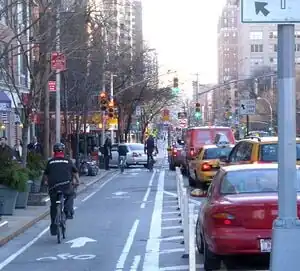
Bike New York - Citi Bike, bicycle sharing system
Wikipedia:
Cycling in New York City is associated with mixed cycling conditions that include dense urban proximities, relatively flat terrain, congested roadways with "stop-and-go" traffic, and streets with heavy pedestrian activity. The city's large cycling population includes utility cyclists, such as delivery and messenger services; cycling clubs for recreational cyclists; and, increasingly, commuters. While New York City developed the country's first bike path in 1894, and recent trends place the city "at the forefront of a national trend to make bicycling viable and safe," competing ideas of urban transportation have led to conflict, as well as ongoing efforts to balance the needs of cyclists, pedestrians, and cars.
Bike New York is an organization based in New York City that encourages cycling and bicycle safety. They are best known for producing the Five Boro Bike Tour, the largest recreational cycling event in the United States. The Tour, which occurs on the first Sunday of May every year, takes 30,000 riders in a 42-mile ride around New York City. Bike New York also produces smaller rides, offers free classes to the public, and develops customized bicycle safety and education programs in and around New York City.
Citi Bike is a privately owned public bicycle sharing system that serves parts of New York City. It is the largest bike sharing program in the United States.[3][5] The system opened to the public in May 2013 with 330 stations and officially with 6,000 bikes, but six weeks later, the actual number in use appeared to be less than 4,300.
Urban sustainability
DoTank, collective that carried out urban interventions in and around New York City between 2009 and 2011
Biodiversity
New York City Audubon - The Welikia Project, Ecology of pre-1609 New York City
Environment quality
wikipedia:Environmental issues in New York City are affected by the city's size, density, abundant public transportation infrastructure, and location at the mouth of the Hudson River. New York's population density has environmental pros and cons. It facilitates the highest mass transit use in the United States, but also concentrates pollution. Gasoline consumption in the city is at the rate the national average was in the 1920s, and greenhouse gas emissions are a fraction of the national average, at 7.1 metric tons per person per year, below San Francisco, at 11.2 metric tons, and the national average, at 24.5 metric tons. New York City accounts for only 1% of United States greenhouse gas emissions while housing 2.7% of its population. In September 2012, New York was named the #1 "America's Dirtiest City," by a Travel+Leisure readership survey that rated the environmental quality of 35 prominent cities in the United States.
Open spaces
- Bronx River Alliance, Video: Bronx River Alliance channel on youtube.com
- Design Trust for Public Space, nonprofit organization dedicated to the future of public space in New York City. "Our projects bring together city agencies, community groups and private sector experts to make a lasting impact — through design — on how New Yorkers live, work and play...Design Trust press release, (April 8, 2014)
- The High Line & Friends of the High Line (Wikipedia) The High Line is a 1-mile (1.6 km) New York City linear park built on a section of an elevated former New York Central Railroad spur, redesigned and planted as an aerial greenway
- People Make Parks supports community groups to contribute to NYC Parks' building and design process
Wikipedia:Parks and recreation in New York City: Major municipal parks in New York City include Central Park, Prospect Park, Flushing Meadows-Corona Park, Forest Park, and Washington Square Park. The largest is Pelham Bay Park, followed by the Staten Island Greenbelt. City Parks Foundation offers more than 1200 free performing arts events in parks across the city each year. The city has 28,000 acres (113 km²) of municipal parkland and 14 miles (22 km) of public municipal beaches.
Trees, woodland and forest
About New York City
Past events
- May 11 -14, 2019 6th National Cultivating Community Composting Forum!
- Mar 4 - 10, 2019 Circular City Week
- May 4, 2014, TD Five Boro Bike Tour
- September 20 - 21, 2014, People's Climate March
- September 22 - 28, 2014, Climate Week NYC
- August 25, 2013, Ecofest
New York, often called New York City or NYC, is the most populous city in the United States, located at the southern tip of New York State on one of the world's largest natural harbors. The city comprises five boroughs, each coextensive with a respective county. The city is the geographical and demographic center of both the Northeast megalopolis and the New York metropolitan area, the largest metropolitan area in the United States by both population and urban area. New York is a global center of finance and commerce, culture, technology, entertainment and media, academics and scientific output, the arts and fashion, and, as home to the headquarters of the United Nations, international diplomacy.
With an estimated population in 2024 of 8,478,072 distributed over 300.46 square miles (778.2 km2), the city is the most densely populated major city in the United States. New York City has more than double the population of Los Angeles, the nation's second-most populous city. With more than 20.1 million people in its metropolitan statistical area and 23.5 million in its combined statistical area as of 2020, New York City is one of the world's most populous megacities. The city and its metropolitan area are the premier gateway for legal immigration to the United States. As many as 800 languages are spoken in New York City, making it the most linguistically diverse city in the world. In 2021, the city was home to nearly 3.1 million residents born outside the United States, the largest foreign-born population of any city in the world.
External links