Nicaragua community action
The aim of this page is to recognise, celebrate and encourage the self-empowerment of community agency networks (CANs) and community groups' activism for climate, environment and many other sustainability topics across Nicaragua.
News
- Solar energy 'like light from heaven' for rural Nicaragua, Nov 13, 2017...irishtimes.com
Networks and sustainability initiatives
- Neighbourhood initiatives across Managua
Social inclusion
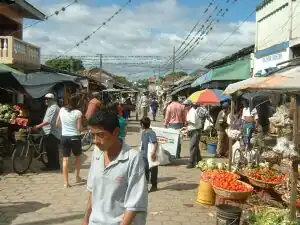
According to the United Nations Development Programme, 48% of the population of Nicaragua live below the poverty line, 79.9% of the population live with less than $2 per day. According to UN figures, 80% of the indigenous people (who make up 5% of the population) live on less than $1 per day.
Health and wellbeing

Although Nicaragua's health outcomes have improved over the past few decades with the efficient utilization of resources relative to other Central American nations, healthcare in Nicaragua still confronts challenges responding to its populations' diverse healthcare needs.
The Nicaraguan government guarantees universal free health care for its citizens. However, limitations of current delivery models and unequal distribution of resources and medical personnel contribute to the persistent lack of quality care in more remote areas of Nicaragua, especially among rural communities in the Central and Atlantic region. To respond to the dynamic needs of localities, the government has adopted a decentralized model that emphasizes community-based preventive and primary medical care.
Ethical consumerism
CECOCAFEN is an organization of coffee cooperatives in Northern Nicaragua that manage a rural and community-based tourism project, which has been developed with support from Lutheran World Relief. Tourism allows farmers to receive new opportunities in alternative markets, harvest coffee and diversify their income. CECOCAFEN offers visitors the opportunity to visit a coffee farm, learn about coffee craftsmanship, and even to stay overnight on a coffee farm and explore with a community guide.
Eco-tourism: Nicaragua's eco-tourism is growing. Nicaragua has three eco-regions, the Pacific, Central and Atlantic which contain volcanoes, tropical rainforest and agricultural land. The majority of the ecolodges and other environmentally-focused touristic destinations are found on Ometepe Island, found in the middle of Lake Nicaragua just an hour boat ride from Granada. While some are foreign-owned, such as the tropical permaculture lodge at Finca El Zopilote, others are owned by local families.
Biodiversity
The fauna of Nicaragua is characterized by a very high level of biodiversity. Much of Nicaragua's wildlife lives in protected areas. There are currently 78 protected areas in Nicaragua, covering more than 22,000 square kilometers (8,500 sq mi), or about 17% of its landmass.
Open spaces
Nearly one fifth of Nicaragua is designated as protected areas like national parks, nature reserves, and biological reserves.
Trees, woodland and forest
The region of great forests is located on the eastern side of the country. Rainforests are found in the Río San Juan Department and in the autonomous regions of RAAN and RAAS. This biome groups together the greatest biodiversity in the country and is largely protected by the Indio Maíz Biological Reserve in the south and the Bosawás Biosphere Reserve in the north. The Nicaraguan jungles, which represent about 9,700 square kilometres (2.4 million acres), are considered the lungs of Central America and comprise the second largest-sized rainforest of the Americas.
About Nicaragua
Nicaragua, officially the Republic of Nicaragua, is the geographically largest country in Central America, comprising 130,370 km2 (50,340 sq mi). With a population of 7,142,529 as of 2024, it is the third-most populous country in Central America after Guatemala and Honduras.
Nicaragua is bordered by Honduras to the north, the Caribbean Sea to the east, Costa Rica to the south, and the Pacific Ocean and shares maritime borders with El Salvador to the west and Colombia to the east. The country's largest city and national capital is Managua, the fourth-largest city in Central America, with a population of 1,055,247 as of 2020. Nicaragua is known as "the breadbasket of Central America" due to having the most fertile soil and arable land in all of Central America. Nicaragua's multiethnic population includes people of mestizo, indigenous, European, and African heritage. The country's most spoken language is Spanish, though indigenous tribes on the Mosquito Coast speak their own languages and English. The mixture of cultural traditions has generated substantial diversity in folklore, cuisine, music, and literature, including contributions by Nicaraguan poets and writers such as Rubén Darío.
External links
- Wikipedia:Nicaragua, Water supply and sanitation in Nicaragua
- Sonati, non-profit organization with an environmental program financed by the profits from their hostels and tours in León and Estelí.