Seattle community action
The aim of this page is to recognise, celebrate and encourage the self-empowerment of community agency networks (CANs) and community groups across Seattle.
 How to capture satellite images in your backyard – and contribute to a snapshot of the climate crisis, The Conversation (Feb 23, 2022)
 - Solar Project Devised by Highline High School Students Wins District Approval, South Seattle Emerald (Feb 07, 2022)
Networks and sustainability initiatives
Community resources
NE Seattle Tool Library - West Seattle Tool Library - Third Place Commons
Climate action
Seattle's Climate Action Plan and the Kyoto Protocol
Open spaces

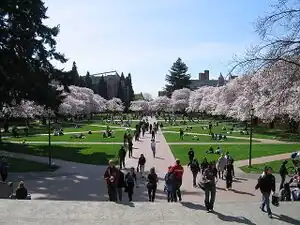
Seattle's mild, temperate marine climate allows year-round outdoor recreation, including walking, cycling, hiking, skiing, snowboarding, kayaking, rock climbing, motorboating, sailing, team sports, and swimming. The city parks system encompasses 485 parks, shorelines, and preserved spaces that total 6,500 acres (2,600 ha)—12 percent of the land area of Seattle. These city-owned facilities include 25 miles (40 km) of boulevards and 120 miles (190 km) of walking and hiking trails, athletic fields, swimming pools, community centers, bathhouses, and performance spaces. The Trust for Public Land ranked Seattle eighth in the United States among municipal parks systems in 2023 and estimates that 99 percent of residents live within a 1⁄2-mile (0.8 km) of a park.
The largest park in the city is Discovery Park, which includes 534 acres (2.16 km2) of forestland and saltwater beaches along the bluffs in Magnolia. Among the most popular Seattle parks are Green Lake, which is ringed by a walking trail; Alki Beach Park on the southwest side of Elliott Bay; Myrtle Edwards Park near the downtown waterfront; Volunteer Park on Capitol Hill; and Seward Park on Lake Washington. Several city parks include panoramic views of the Seattle skyline, including Kerry Park on Queen Anne Hill and Gas Works Park in Wallingford, which features the preserved superstructure of a coal gasification plant closed in 1956.
Seattle has a network of recreational and commuting trails for cyclists and pedestrians, mainly repurposed from disused railroads or built alongside regional highways. The Burke–Gilman Trail, which travels for 27 miles (43 km) along the Ship Canal and Lake Washington between Ballard and Bothell, first opened in 1978 on a former railroad. The Mountains to Sound Trail connects the Interstate 90 corridor, including the north side of the Homer M. Hadley Memorial Bridge, and is planned to be extended to Snoqualmie. Other non-motorized paths include the Overlook Walk, which opened in 2024 to connect Pike Place Market to the downtown waterfront via a set of overpasses that integrate with an expansion of the Seattle Aquarium. Also popular among Seattle residents are hikes and skiing in the nearby Cascade or Olympic Mountains and kayaking and sailing in the region's waterways.
Golden Gardens Park is a public park in Ballard, a neighborhood of Seattle, Washington. The park includes wetlands, beaches, hiking trails, and picnic and playground areas. The park's bathhouse was designated a historic landmark by the City of Seattle in 2005.
Parks information from seattle.gov
Trees, woodland and forest
Cycling activism
Cycling in Seattle
There are extensive multi-use car-free regional pathways linking the city and county to the surrounding areas, including the King County Regional Trails System, which has 175 miles (282 km) of trails throughout the county. Many of the trails were converted from former railways, including the popular Burke-Gilman Trail. The Seattle Department of Transportation aims to develop a 608.3-mile (979.0 km) network of bike lanes, including lanes on streets, protected bike lanes, and trails, within the city by 2034. A pilot program allowing private dockless bike sharing companies to operate within the city began in July 2017, making Seattle the first major city in North America to feature such a system.
see also: Washington, Cycling activism
Other initiatives
- The Bike Shack, volunteer-run, donation-funded community bike shop
Maps
Food activism
Alleycat Acres - Beacon Food Forest Permaculture Project - Seattle Neighborhood Farmers Markets
Reduce, reuse, repair and recycle
Seattle.gov's Stop Phone Books page
Social inclusion
In the Seattle King County area, there were estimated to be 11,751 homeless people living on the streets or in shelters. On January 24, 2020, the count of unsheltered homeless individuals was 5,578. The number of individuals without homes in emergency shelters was 4,085 and the number of homeless individuals in transitional housing was 2,088, for a total count of 11,751 unsheltered people.
The percentages of individuals experiencing homelessness by race was: White 48%, African American 25%, Asian 2%, Native American 15%, Native Hawaiian or Pacific Islander 4%, Multi-racial 6%. In a survey conducted in 2019, 84% of homeless people in Seattle/King County lived in Seattle/King County prior to losing their housing, 11% lived in another county in Washington prior to losing their housing, and 5% lived out of state prior to losing their housing. Homelessness in Seattle is considered to be a crisis. It has been proposed that to address the crisis Seattle needs more permanent supportive housing.
A 2022 study found that differences in per capita homelessness rates across the country are not due to mental illness, drug addiction, or poverty, but to differences in the cost of housing, with West Coast cities like Seattle having homelessness rates five times that of areas with much lower housing costs like Arkansas, West Virginia, Detroit, and Chicago even though the latter locations have high burdens of opioid addiction and poverty.: 1
Towards sustainable economies
News and comment
2017
How Seattle Is Dismantling a NIMBY Power Structure, Apr 3[1]
2016
Can Retail Space be an Extension of the Public Realm? A Look at Seattle's Third Place Books, January 5[2]
2015
These urban farmers want to feed the whole neighborhood — for free, March 13[3]
2012
It's Not a Fairytale: Seattle to Build Nation's First Food Forest,[4] February 21
2011
Seattle City Council unanimously votes to ban plastic carry out bags,[5] December 19
Seattle first in U.S. to mandate choice on yellow pages delivery,[6] May 5
2010
Seattle City website declares – 2010 The Year of Urban Agriculture,[7] February 2
News sources
- South Seattle Emerald, amplifying the authentic narratives of South Seattle
About Seattle
Seattle ( see-AT-əl) is the most populous city in the U.S. state of Washington and in the Pacific Northwest region of North America. With a population of 755,078 in 2023, it is the 18th-most populous city in the United States. The city is the county seat of King County, the most populous county in Washington. The Seattle metropolitan area's population is 4.02 million, making it the 15th-most populous in the United States. Its growth rate of 21.1% between 2010 and 2020 made it one of the country's fastest-growing large cities.
Seattle is situated on an isthmus between Puget Sound, an inlet of the Pacific Ocean, and Lake Washington. It is the northernmost major city in the United States, located about 100 miles (160 km) south of the Canadian border. A gateway for trade with East Asia, the Port of Seattle is the fourth-largest port in North America in terms of container handling as of 2021.
References
- ↑ nextcity.org
- ↑ Project for Public Spaces
- ↑ Grist
- ↑ takepart.com
- ↑ seattlechannel.org
- ↑ seattle.gov
- ↑ City Farmer News