Thailand community action
The aim of this page is to recognise, celebrate and encourage the self-empowerment of community agency networks (CANs) and community groups' activism for climate, environment and many other sustainability topics across Thailand.
News
 Thailand bans imports of plastic waste to curb toxic pollution, theguardian.com (Jan 07, 2025)
 - Community-led approach to mangrove restoration in southern Thailand based on beekeeping, news.mongabay.com (Jun 18, 2024)
- Is it time to choose sustainable rice?, Wicked Leeks (Jul 17, 2023) — You might not know it, but traditional rice cultivation emits serious levels of greenhouse gases. Clare Hargreaves interviews a man working with rice farmers to get climate-friendlier rice onto British dinner plates.
Video
Food activism

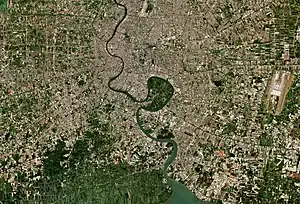
In early 2000, urban gardens were started in Bangkok under the direction of the NGO, Thailand Environment Institute (TEI). Bangkok has a population of 12 million, and 39% of the land in the city vacant due to rapid expansion of the 1960's to 80's.
The two urban gardens initiated by TEI are in Bangkok Noi and Bangkapi and the stated main tasks were to:
- Teach members of the communities the benefits of urban green space.
- Create the social framework to plan, implement, and maintain the urban green space.
- Create a process of method to balance the needs of the community with the needs of the larger environmental concerns.
Climate action
The Bangkok250 and Green Bangkok 2030 projects aim to make the capital more walkable, reducing emissions and improving air quality.
Thailand is among the world's ten countries that are most exposed to climate change. In particular, it is highly vulnerable to rising sea levels and extreme weather events.
Biodiversity
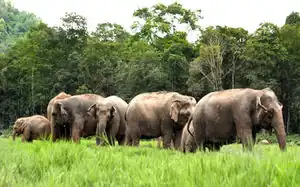
Though Thai elephants are highly admired throughout the country and in Thai history, the threat against these elephants comes directly from those who most value them, the human explicators. Poaching for ivory, elephant calves, illegal logging and roaming city streets for money are just some of the few threats the elephants face. Elephant Nature Park sees this these growing threats and works against them to help restore the health, well-being, safety, and environment for the elephants of its country, Thailand.[1]
Wetlands
Mekong

The Mekong or Mekong River (UK: mee-KONG, US: may-KAWNG) is a transboundary river in East Asia and Southeast Asia. It is the world's twelfth-longest river and the third-longest in Asia with an estimated length of 4,909 km (3,050 mi) and a drainage area of 795,000 km2 (307,000 sq mi), discharging 475 km3 (114 cu mi) of water annually.From its headwaters in the Tibetan Plateau, the river runs through Southwest China (where it is officially called the Lancang River), Myanmar, Laos, Thailand, Cambodia, and southern Vietnam. The extreme seasonal variations in flow and the presence of rapids and waterfalls in the Mekong make navigation difficult, though the river remains a major trade route between Tibet and Southeast Asia. The construction of hydroelectric dams along the Mekong in the 2000s through the 2020s has caused serious problems for the river's ecosystem, including the exacerbation of drought.
Environmental issues
Drought linked to a changing climate and dozens of hydroelectric dams are damaging the Mekong ecosystem. When drought ends and the inevitable floods begin, the effects of Mekong dams on flood pulse dynamics over the entire Lower Mekong are poorly understood.
Sewage treatment is rudimentary in towns and urban areas throughout much of the Mekong's length, such as Vientiane in Laos. Water pollution impacts the river's ecological integrity as a result.[citation needed]
Much of the 8.3 billion tonnes of plastic present on earth makes its way to the oceans. Ninety percent of plastic in the oceans is flushed there by just 10 rivers. The Mekong is one of them.
A growing number of academics, NGOs, and scientists have urged the international community and the Mekong River Commission to reduce the use of hydropower, giving concerns of long-term sustainability. Some of them have urged an immediate moratorium on new construction of hydropower projects and a shift to solar and other forms of renewable energy, which are becoming more competitive and faster to install.
Indochina mangroves
The Indochina mangroves are a large mangrove ecoregion on the coasts of Thailand, Cambodia, Vietnam and Malaysia in Southeast Asia.
Mangroves everywhere are vulnerable to clearance for logging and for agricultural development, and in this region have been particularly affected by the Vietnam War damage, particularly America's chemical weapon of defoliants, the Rainbow Herbicides, most notably Agent Orange which destroyed and devastated entire mangrove forests. In Vietnam there has been a post-war program of replanting to try and revive mangrove habitats.
Rural sustainability
Rain Tree is continuously looking for new opportunities and ideas as to how to better help rural people. The staff at the foundation are from various local ethnic tribal groups in Thailand.
Permaculture
News archive
2009-2020
- With social media and academics, Thai villagers save ancestral forest. Sep 29, 2020...[2]
- Reclaiming mangroves for shrimp production, Sep 22, 2016...[3]
- One Woman's Solar Leadership (& Challenges) In Thailand, Aug 23, 2016..[4]
- Thailand Solar Power To Surpass All Southeast Asia, July 15, 2015..[5]
- Worried about the looming water shortage in many parts of Thailand, writer Veera Prateepchaikul calls for the drafting and implementation of a comprehensive water policy in the country,[6] February 13, 201o.
- 2009 SEED Award winners: "Carbon bank and village development". This innovative initiative of national NGOs and an academic institution aims to encourage, support and enhance community-based indigenous forestry through carbon credit trading to enable successful climate change adaptation and socioeconomic development for local communities and biodiversity conservation.[7] May 12, 2009
References
Environmental issues in Thailand
Thailand's dramatic economic growth has caused numerous environmental issues. The country faces problems with air, declining wildlife populations, deforestation, soil erosion, water scarcity, and waste issues. According to a 2004 indicator, the cost of air and water pollution for the country scales up to approximately 1.6–2.6% of GDP per year. As such, Thailand's economic growth has come at great cost in damage to its people and environment.
Thailand's Twelfth National Economic and Social Development Plan (2017-2021) warns that, "At present the country's natural resources and environmental quality are deteriorating, and have become a weakness in maintaining the basis of production, services and sustainable living. A large volume of the natural resources stock has been utilized for development, resulting in their continuous degradation. The forests have been depleted, the soil has become infertile, and biodiversity has been threatened. While exhibiting a future risk of water shortages, the existing supply of water has not been able to meet the demands of the various sectors. Conflicts over the use of natural resources stem from the unfair allocation of access and exploitation. Moreover, environmental problems have risen along with economic growth and urbanization. All of these problems have affected the quality of life and have added greater economic costs.": 14–15, 132
Poverty
In 2016, 5.81 million people lived in poverty, or 11.6 million people (17.2% of population) if "near poor" is included.
Near you
About Thailand
Thailand, officially the Kingdom of Thailand and historically known as Siam (the official name until 1939), is a country in Southeast Asia on the Indochinese Peninsula. With a population of almost 66 million, it spans 513,115 square kilometres (198,115 sq mi). Thailand is bordered to the northwest by Myanmar, to the northeast and east by Laos, to the southeast by Cambodia, to the south by the Gulf of Thailand and Malaysia, and to the southwest by the Andaman Sea; it also shares maritime borders with Vietnam to the southeast and Indonesia and India to the southwest. Bangkok is the state capital and largest city.