Whaling
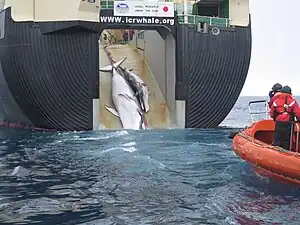

Whaling is the hunting of whales for their products such as meat and blubber, which can be turned into a type of oil that was important in the Industrial Revolution. Whaling was practiced as an organized industry as early as 875 AD. By the 16th century, it had become the principal industry in the Basque coastal regions of Spain and France. The whaling industry spread throughout the world and became very profitable in terms of trade and resources. Some regions of the world's oceans, along the animals' migration routes, had a particularly dense whale population and became targets for large concentrations of whaling ships, and the industry continued to grow well into the 20th century. The depletion of some whale species to near extinction led to the banning of whaling in many countries by 1969 and to an international cessation of whaling as an industry in the late 1980s.Archaeological evidence suggests the earliest known forms of whaling date to at least 3000 BC, practiced by the Inuit and other peoples in the North Atlantic and North Pacific. Coastal communities around the world have long histories of subsistence use of cetaceans, by dolphin drive hunting and by harvesting drift whales. Widespread commercial whaling emerged with organized fleets of whaling ships in the 17th century; competitive national whaling industries in the 18th and 19th centuries; and the introduction of factory ships and explosive harpoons along with the concept of whale harvesting in the first half of the 20th century. By the late 1930s, more than 50,000 whales were killed annually. In 1982, the International Whaling Commission (IWC) decided that there should be a pause on commercial whaling on all whale species from 1986 onwards because of the extreme depletion of most of the whale stocks.