Africa community action
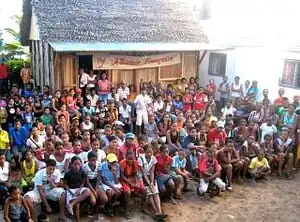
The aim of this page is to recognise, celebrate and encourage the self-empowerment of community agency networks (CANs) and community groups' activism for climate, environment and many other sustainability topics across Africa. It's the beginnings of a portal for Africa community action. The majority of our information about this is collated via our place pages...Near you. Most of this page focuses on Africa community action topics.
News
 Think your efforts to help the climate don’t matter? African philosophers disagree, theconversation.com (Jan 27, 2025)
 - It’s time for Africa to join the Fossil Fuel Non-Proliferation Treaty, Boniface Mwangi, africanarguments.org (Jan 14, 2025)
- Resilient farming in northern Ghana, Agroecology blueprint for other drought-prone regions across Africa, news.mongabay.com (Dec 05, 2024)
Video
Food
Citizens data initiative
Women produce approximately 80 per cent of Africa’s food but own less than 10 per cent of the land...Ripple Effect: Observations from a visiting organic farmer, Guy Singh-Watson, 3rd December 2024, wickedleeks.riverford.co.uk
Community energy
- Solar Sister eradicating energy poverty by empowering women with economic opportunity
- The 'Fuel from Waste' Network
- M-KOPA Solar
- ColdHubs
Social inclusion
Sustainable livelihood
dadamac.net, Collaboration, Education, Livelihoods and Development in a Changing World
Community resources
Citizens data initiative
Wealth and poverty in Africa – interactive, 2011...guardian.co.uk, 25 December 2011
Apps for sustainability
Sharing

Ubuntu (Zulu pronunciation: [ùɓúntʼù]; meaning 'humanity' in some Bantu languages, such as Zulu) describes a set of closely related Bantu African-origin value systems that emphasize the interconnectedness of individuals with their surrounding societal and physical worlds. "Ubuntu" is sometimes translated as "I am because we are" (also "I am because you are"), or "humanity towards others" (Zulu umuntu ngumuntu ngabantu). In Xhosa, the latter term is used, but is often meant in a more philosophical sense to mean "the belief in a universal bond of sharing that connects all humanity".
Climate action
- I Lead Climate Action Initiative, Pan-African movement carrying out grassroot-based climate action to address the climate crisis in Africa.
- Oladosu Adenike blog, Oladosu Adenike is an ecofeminist, climate justice activist, eco-reporter and the founder of ILeadClimate. The Ecofeminist Channel on youtube.com added 14:04, 11 March 2024 (UTC)
- 350africa.org
Sustainable transport
Urban sustainability
Africa now has 350 million urban dwellers, more than the populations of Canada and the United States combined. Asia and Africa are expected to double their urban populations to roughly 3.4 billion by 2030...Worldwatch Institute, 2007.
Ecological restoration

.jpg)
This page is the beginnings of a portal for Africa community action in response to Ecological emergency. The majority of our information about this is collated and can be shared via our place pages...Near you.
About Africa
Africa is the world's second-largest and second-most populous continent after Asia. At about 30.3 million km2 (11.7 million square miles) including adjacent islands, it covers 20% of Earth's land area and 6% of its total surface area. With nearly 1.4 billion people as of 2021, it accounts for about 18% of the world's human population. Africa's population is the youngest among all the continents; the median age in 2012 was 19.7, when the worldwide median age was 30.4. Based on 2024 projections, Africa's population will reach 3.8 billion people by 2099. Africa is the least wealthy inhabited continent per capita and second-least wealthy by total wealth, ahead of Oceania. Scholars have attributed this to different factors including geography, climate, corruption, colonialism, the Cold War, and neocolonialism. Despite this low concentration of wealth, recent economic expansion and a large and young population make Africa an important economic market in the broader global context. Africa has a large quantity of natural resources resources, including diamonds, sugar, salt, gold, iron, cobalt, uranium, copper, bauxite, silver, petroleum, natural gas, cocoa beans, and tropical fruit.
The continent is surrounded by the Mediterranean Sea to the north, the Arabian Plate and the Gulf of Aqaba to the northeast, the Indian Ocean to the southeast and the Atlantic Ocean to the west. The continent includes Madagascar and various archipelagos. It contains 54 fully recognised sovereign states, eight cities and islands that are part of non-African states, and two de facto independent states with limited or no recognition. This count does not include Malta and Sicily, which are geologically part of the African continent. Algeria is Africa's largest country by area, and Nigeria is its largest by population. African nations cooperate through the establishment of the African Union, which is headquartered in Addis Ababa.
Environmental issues in Africa
Environmental issues in Africa are caused by anthropogenic effects on the African natural environment and have major impacts on humans and nearly all forms of endemic life. Issues include desertification, problems with access to safe water supply, population explosion and fauna depletion. These issues are ultimately linked to over-population in Africa, as well as on a global scale. Nearly all of Africa's environmental problems are geographically variable and human induced, though not necessarily by Africans.
Near you
See also'