Sustainable livelihood
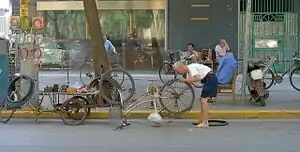
Sustainable livelihood is about meaningful work opportunities for all, especially young people, but also all aspects of what might be called quality of life at work, including for example work satisfaction, work/life balance and fair reward. A sustainable community provides livelihood opportunities for local people that need them,[1] especially young people. Opportunity can be encouraged through a variety of approaches, not just by more traditional or conventional means. Social inclusion involves economic inclusion. To get to a future of work as if people and planet mattered, it seems unlikely that there be a 'silver bullet' type solution, rather it may be that a myriad of interlinking solutions will help.
"Environmentalism can't succeed until it confronts the destructive nature of modern work - and supplants it." The Ecology of Work by Curtis White, Published in the May/June 2007 issue of Orion magazine
 ‘Diversion’ trees to protect shea trees and their livelihoods planted by women in Ghana, news.mongabay.com (Mar 08, 2025)
 - The dream to restore a special forest taking root in the high Andes, news.mongabay.com (Feb 14, 2025)
- ‘We can’t believe you would just trust us’: why social assistance shouldn’t come with strings attached, theconversation.com (Jan 02, 2025)
Networks
- Platform Cooperativism, a growing movement that builds a fairer future of work
Community action projects
- develop Community Currencies
- develop local part time and jobshare registers
- develop and support cooperatives, social enterprise, not-for-profit, community interest companies, people centred economic development, self-employment, home-working, part time work, jobsharing, flexible working, work/life balance and fair reward, and initiatives to improve working conditions
- develop and support meaningful and satisfying work, work as if people and planet mattered, fair trade, co-design and co-production, innovation and creativity
- encourage e-work, telework clubs and teleconferencing facilities so that more people can work closer to home
- encourage Free stuff or the gift economy, sharing, downshifting and simple living
- find ways to ensure that the contribution of unpaid work is valued and respected by the community
- microfinance initiatives
- slow money initiatives
- support initiatives to make the wider economy more sustainable such as basic income, shorter working weeks, better work / life balance, minimum wage and living wage initiatives, eradication of child labour and slavery, tackling widening and destablising wealth inequality, and ways of redefining progress
- sustain the customs of communal work, barnraising and potlatch
- support initiatives such as the (USA) Caring Economy Campaign
Events
 Aug 12, 2025 (Tue) — International Youth Day, awareness day designated by the United Nations taking place on Aug 12 each year, un.org
- Oct 07, 2025 (Tue) — World Day for Decent Work, October 7 is the World Day for Decent Work, ituc-csi.org
- Nov 13, 2025 (Thu) — World Kindness Day, Nov 13, annually, highlighting good deeds in the community focusing on the positive power and the common thread of kindness for good which binds us, randomactsofkindness.org
Citizens data initiative
Unpaid work
- "Unpaid work (parenting, growing food for family and community needs, maintaining households, volunteering in community service, do-it-yourself home and community construction, and repair projects) is estimated as some 50 % of all production in OECD countries and 60 to 65 percent in developing countries." Hazel Henderson
Work life imbalnce
- 22 per cent of the global workforce, or 614.2 million workers, are working "excessively" long hours. International Labour Organization, June 7 2007
Co-operatives
- The United Nations estimated in 1994 that the livelihood of nearly 3 billion people, or half of the world's population, was made secure by co-operative enterprise.[2]
- The Global300 Report states that the world's largest co-operative enterprises, have collective revenues of USD 1.6 trillion, which are comparable to the GDP of the world’s ninth largest economy - Spain.[3]
- The Emilia Romagna region of northern Italy has more than 15,000 cooperatives, which contribute over one-third of the region’s GDP.[4]
Slavery
- 20.9 million men, women and children around the world are in slavery. ILO
- Child Slavery affects an estimated 5.5 million children around the world.[5]
Quotes
"The name of our proper connection to the Earth is "good work"[6] Wendell Berry
“What we enviros need to understand is the centrality of work in people’s lives—and that in a society with deep social insecurity, your job is everything,” says Uehlein. “One’s livelihood, retirement, hopes, and dreams. We have everything to fear from an environmental movement that is silent about workers. Sustainability starts at the kitchen table, meaning our kid’s education, savings, food, and next job.” Joe Uehlein[7]
"In an ideal society, everyone should work for the wellbeing of others." Mencius
Research
- Reimagining Pay, darkmatterlabs.notion.site, added 17:37, 5 November 2021 (UTC)
- Livelihoods information on Eldis, online information service providing free access to relevant, up-to-date and diverse research on international development issues.
- Working time in the European Union: the Netherlands, 2009 Eurofound
Other resources
- Promoting safety and health in a green economy, 14 March 2012, ilo.org
- Rethink the idea of “Jobs”, Change-Making
Livelihood security
- Livelihood security policy, Concern worldwide, 25 February 2011
- To Claim our Rights: livelihood security, human rights and sustainable development, Caroline Moser & Andy Norton, with Tim Conway, Clare Ferguson, Polly Vizard (PDF), Overseas Development Institute 2001
- The household livelihood security concept, T.R. Frankenberger and M.K. McCaston, 1998 FAO Corporate document depository
Barn raising
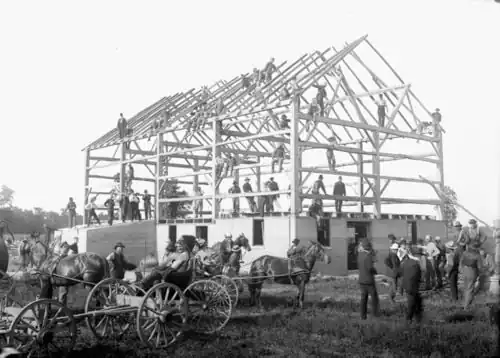
A barn raising, also historically called a "raising bee" or "rearing" in the U.K., describes a collective action of a community, in which a barn for one of the members is built or rebuilt collectively by members of the community. Barn raising was particularly common in 18th- and 19th-century rural North America. A barn was a necessary structure for any farmer, for example for storage of cereals and hay and keeping of animals. Yet a barn was also a large and costly structure, the assembly of which required more labor than a typical family could provide. Barn raising addressed the need by enlisting members of the community, unpaid, to assist in the building of their neighbors' barns. Because each member was entitled to recruit others for help, the favor would eventually return to each participant.
Communal work
Communal work is when a gathering takes place to accomplish a task or to hold a competition. A number of cultures have such gatherings, often for the purpose of holding a competition, as in a spelling bee, or for providing manual labour, as in a barn raising.
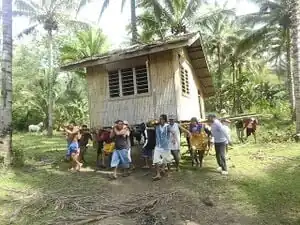
Especially in the past, the tasks were often major jobs, such as clearing a field of timber or raising a barn, that would be difficult to carry out alone. It was often both a social and utilitarian event. Jobs like corn husking or sewing, could be done as a group to allow socializing during an otherwise tedious chore. Such gatherings often included refreshments and entertainment provided by the group.
Cooperative
A cooperative ("coop") or co-operative ("co-op") is an autonomous association of people who voluntarily cooperate for their mutual social, economic, and cultural benefit. Cooperatives include non-profit community organizations and businesses that are owned and managed by the people who use their services (a consumer cooperative) or by the people who work there (a worker cooperative) or by the people who live there (a housing cooperative), hybrids such as worker cooperatives that are also consumer cooperatives or credit unions, multi-stakeholder cooperatives such as those that bring together civil society and local actors to deliver community needs, and second and third tier cooperatives whose members are other cooperatives.
Decent work
Decent work is the availability of employment in conditions of freedom, equity, human security and dignity.
According to the International Labour Organization ILO, Decent Work involves opportunities for work that is productive and delivers a fair income, security in the workplace and social protection for families, better prospects for personal development and social integration, freedom for people to express their concerns, organize and participate in the decisions that affect their lives and equality of opportunity and treatment for all women and men.
Campaigns
50forfreedom, campaign to end modern slavery
See also: Buckminster Fuller, Community and voluntary action, Community resources, Localism, Advising people about cooperatives, Small Enterprises and Cooperatives, Category:Cooperatives
local information and news can be found, or shared, via our many location pages
External links
- Wikipedia: Barn raising, Child labor, Communal work, Cooperatives, Decent work, James Robertson (activist), Jeremy Rifkin, Mondragon Corporation, Refusal of work, Right Livelihood Award, Work–life balance
Creative commons
Labour Behind the Label is a campaign that supports garment workers' efforts worldwide to improve their working conditions, through awareness raising, information provision and encouraging international solidarity between workers and consumers.
Other
Anti-Slavery, What is modern slavery?
References
- ↑ It may be argued that this is simplistic and anti free flow of labour. It is not about communities being anti, simply not overly dependent on inflow or at risk of destabilising outflow.
- ↑ Co-operative facts and figures
- ↑ Global300 Report
- ↑ Worldwatch Institute
- ↑ What is modern slavery?, antislavery.org
- ↑ medium.com, Feb 18, 2019
- ↑ Can We Earn a Living on a Living Planet? On the Commons