Bangladesh community action
The aim of this page is to recognise, celebrate and encourage the self-empowerment of community agency networks (CANs) and community groups' activism for climate, environment and many other sustainability topics across Bangladesh.
News
 ‘We can’t believe you would just trust us’: why social assistance shouldn’t come with strings attached, theconversation.com (Jan 02, 2025)
 - Climate refugees have often seen far too much. But human-centred design, done with empathy and sensitivity to trauma, can help them recover their agency, Daily Alternative (Nov 05, 2024)
- Unrest in Bangladesh reflects young people’s struggle to find decent work in the world’s poorest nations, theconversation.com (Aug 20, 2024)
- ‘Global weirding’: climate whiplash hitting world’s biggest cities, study reveals, theguardian.com (Mar 12, 2025)
- Only seven countries worldwide meet WHO dirty air guidelines, study shows, theguardian.com (Mar 11, 2025) — Governments could clean their air with policies such as funding renewable energy projects and public transport; building infrastructure to encourage walking and cycling; and banning people from burning farm waste.
- Many cities are banning ads for airlines, SUVs and fossil fuels – and yours could be next, theconversation.com (Mar 10, 2025)
Video
Food activism
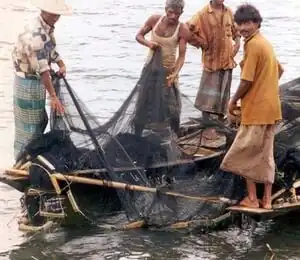
Small-scale fish farming in Bangladesh


For many people in Bangladesh small-scale fish farming is an important opportunity to generate income and is a significant nutritional source providing protein-rich food all year round. It comprises of a range of options that can be adapted to suit the needs and capacity of people living in rural Bangladesh.
The two approaches commonly implemented on a small scale are:
- Local pond fish farming
- Open water fish farming in lakes, rivers, dams and reservoirs
The benefit to low-income farmers is that they are able to invest in fish cultivation when there is sufficient income, which will then be able to generate additional income and food when other sources of income are limited.
Much of Bangladesh is flooded annually during the monsoon season as water flows into the country through the Ganga (Ganges), Brahmaputra and Meghna rivers. This provides an extensive range of habitats for wild and cultivated fish species. Fish catches are highest after the monsoon rains when supplies of other foods, such as rice, are low. With so much water, fishing plays a vital role in the economy of rural villages.
Community energy
- solshare.com, added 15:39, 26 January 2024 (UTC)
Wind power
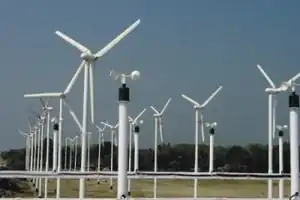
Wind energy or wind power is being used in Bangladesh to combat the country's dependence on Natural Gas.[1] Grameen Shakti plans to make renovations for the wind powered plants on the coastal areas of Bangladesh. Bangladesh's Local Government Engineering Department established that the annual wind speed in the coastal belt ranges from 2.96 meters per second to 4.54 meters per second.[2]
With 90 percent of Bangladesh's electricity produced by natural gas, an alternative energy like wind power is being considered. Wind energy is cleaner and cheaper to maintain and does not create as much pollution as natural gas. Bangladesh has a 724 kilometer long coastline and also has many small islands that are capable of collecting strong winds provided by it's northeast region and winter month breezes.[3]
Towards sustainable economies
The Grameen Bank of Bangladesh is a pioneer in microfinance - not only microcredit, but savings and other services.
It is now a very large member-owned company with many subsidiary businesses.
Social inclusion
- ActionAid Bangladesh, press releases, actionaidbd.org, added 16:46, 9 December 2023 (UTC)
- The Dhaka Project
Biodiversity
Environment quality
'Let's Clean Bangladesh' – a regular program of The Dhaka Project - Wikipedia: Floods in Bangladesh, Water supply and sanitation in Bangladesh, Water management in Dhaka
Sea level rise
Societies can adapt to sea level rise in three different ways: implement managed retreat, accommodate coastal change, or protect against sea level rise through hard-construction practices like seawalls or soft approaches such as dune rehabilitation and beach nourishment. Sometimes these adaptation strategies go hand in hand, but at other times choices have to be made among different strategies. For some human environments, such as so called sinking cities, adaptation to sea level rise may be compounded by other environmental issues such as subsidence. Natural ecosystems typically adapt to rising sea levels by moving inland; however, they might not always be able to do so, due to natural or artificial barriers.
Maps
Land projected to be below annual flood level in 2030 and beyond, coastal.climatecentral.org
Sea Level Rise, information from climatecentral.org
Maps
Research
About Bangladesh

Bangladesh, officially the People's Republic of Bangladesh, is a country in South Asia. It is the eighth-most populous country in the world and among the most densely populated with a population exceeding 170 million within an area of 148,460 square kilometres (57,320 sq mi). Bangladesh shares land borders with India to the north, west, and east, and Myanmar to the southeast. To the south, it has a coastline along the Bay of Bengal. To the north, it is separated from Bhutan and Nepal by the Siliguri Corridor, and from China by the mountainous Indian state of Sikkim. Dhaka, the capital and largest city, is the nation's political, financial, and cultural centre. Chittagong is the second-largest city and the busiest port of the country. The official language is Bengali. Islam is the official and largest religion and Bengali Muslims form the largest ethnoreligious group in the country.
Bangladesh is part of the historic and ethnolinguistic region of Bengal, which was divided during the Partition of British India in 1947 as the eastern exclave of the Dominion of Pakistan. Ancient Bengal was known as Gangaridai and was a stronghold of pre-Islamic kingdoms. The Muslim conquest after 1204 led to the sultanate and Mughal periods, during which an independent Bengal Sultanate and wealthy Mughal Bengal transformed the region into an important centre of regional affairs, trade, and diplomacy. The Battle of Plassey in 1757 marked the beginning of British rule for next 200 years. The creation of Eastern Bengal and Assam in 1905 set a precedent for the emergence of Bangladesh. The All-India Muslim League, which was founded in Dhaka in 1906, fought for a separate Bengali Muslim homeland in the Eastern Bengal, which was proposed in the Lahore Resolution in 1940 by A. K. Fazlul Huq, the first Prime Minister of Bengal. The present-day territorial boundary was established with the announcement of the Radcliffe Line.
In 1947, East Bengal became the most populous province in the Dominion of Pakistan and was renamed East Pakistan, with Dhaka as the legislative capital. The Bengali Language Movement in 1952, the 1958 Pakistani coup d'état, and the 1970 Pakistani general election spurred Bengali nationalism and pro-democracy movements. The refusal of the Pakistani military junta to transfer power to the Awami League, led by Sheikh Mujibur Rahman, triggered the Bangladesh Liberation War in 1971. The Mukti Bahini waged a successful armed revolution; the conflict saw the Bangladeshi genocide. The country came into existence on 16 December 1971 after the surrender of Pakistan, ending the 9-month long Liberation War.
After the war, Sheikh Mujib became the leader of the country. Mujib's assassination in 1975 led to the rise of Ziaur Rahman, who himself was assassinated in 1981. The 1980s was dominated by the presidency of Hussain Muhammad Ershad, who was overthrown in a mass uprising in 1990. After 1990, the "Battle of the Begums" between Khaleda Zia and Sheikh Hasina defined Bangladesh's politics and history for next three decades. Following the overthrow of Hasina in a student–led mass uprising in August 2024, an interim government led by Nobel Peace laureate Muhammad Yunus took power.
Bangladesh is a unitary parliamentary republic based on the Westminster system. It is a middle power with the second-largest economy in South Asia. Bangladesh is home to the third-largest Muslim-majority population and the fifth-most spoken native language. It maintains the third-largest military in South Asia and is the largest contributor to UN peacekeeping operations. It consists of eight divisions, 64 districts, and 495 sub districts, and includes the largest mangrove forest in the world. However, Bangladesh has one of the largest refugee populations in the world and continues to face challenges such as corruption, political instability, overpopulation, and the effects of climate change. It has twice chaired the Climate Vulnerable Forum and hosts the headquarters of the BIMSTEC. Bangladesh is also a founding member of SAARC and a member of the OIC and the Commonwealth of Nations.
References
- ↑ https://web.archive.org/web/20210505110837/https://bangladesheconomy.wordpress.com/2009/09/12/power-cell-recommends-100mw-wind-power-plant-in-chittagong/
- ↑ http://bangladesheconomy.wordpress.com/2009/09/12/power-cell-recommends-100mw-wind-power-plant-in-chittagong/
- ↑ http://english.peopledaily.com.cn/200507/09/eng20050709_195186.html