Community resources China
This article is an offshoot of China community action focusing on community resources and assets. Resources such as community involvement, networks and events (people and relationships) can be considered as primary resources. Also resources are the activism and physical assets (or what citizens value), such as green spaces and biodiversity, cycle lanes, etc, from other China pages.
Food activism

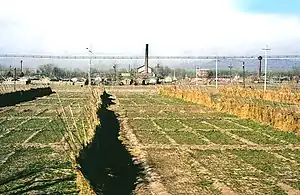
Beijing's increase in land area from 4,822 km² in 1956 to 16,808 km² in 1958 led to the increased adoption of peri-urban agriculture. Such "suburban agriculture" led to more than 70% of non-staple food in Beijing, mainly consisting of vegetables and milk, to be produced by the city itself in the 1960s and 1970s. Recently, with relative food security in China, periurban agriculture has led to improvements in the quality of the food available, as opposed to quantity. One of the more recent experiments in urban agriculture is the Modern Agricultural Science Demonstration Park in Xiaotangshan.[1]
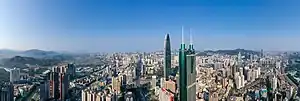
Shenzhen, China, was once a small farming community and is now a fast growing metropolis because the Chinese government has designated the region an open economic zone.
Traditionally, Chinese cities have been known to mix agricultural activities within the urban setting. Due to the large and growing population in China, the government supports urban self-sufficiency in food production. Shenzhen's village structure, sustainable methods, and new agricultural advancements initiated by the government have been strategically configured to supply food for this growing city.[2]
chinese language websites for city farmers, from City Farmer News
Community energy
Community resources
- Chaihuo Maker Space, Shenzhen
- New workshop - XinCheJian, Hackerspace in Shanghai
Maps
See also
- Topic overview: Food activism, Community energy, Community resources, Community and voluntary action
References
- ↑ Periurban Agriculture Development in China, Jianming, Cai, Urban Agriculture Magazine volume 9, 2003-04-01. Accessed 2007-07-12
- ↑ Pepall, Jennifer. New Challenges for Chinas Urban Farms IDRC Report (1997a) 21.3.
External links
- United Nations Environment Programme (UNEP) Chinese-language homepage of its website.
- United Nations Development Programme China