Feeding Everyone if Industry is Disabled
"Paper" is not in the list (Book, Course, Encyclopedia, Project documentation, Research, Guide) of allowed values for the "Publication type" property.
A number of risks could cause widespread electrical failure and temporary global electronics loss, including a series of high-altitude electromagnetic pulses (HEMPs) caused by nuclear weapons, an extreme solar storm, and a coordinated cyber attack. Since modern industry depends on electricity and electronics, it is likely there would be a collapse of the functioning of industry and machines in these scenarios. As our current high agricultural productivity depends on industry (e.g. for fertilizers) it is generally assumed that there would be mass starvation in these scenarios. We model the loss in current agricultural output due to losing industry. Then we analyze compensating strategies such as reducing edible food fed to animals and turned into biofuels, reducing food waste, burning wood in landfills for energy, phosphorus, and potassium, and planting a high fraction of legumes to fix nitrogen. We find that these techniques could feed everyone, but extracting calories from agricultural residues, fishing with wind-powered ships and the backup plan of expanding planted area could feed everyone several times over.
Keywords
solar storm, high-altitude electromagnetic pulse, computer virus, global catastrophic risk, existential risk, industry, food, electricity
See also
- Feeding Everyone No Matter What - The full book main page
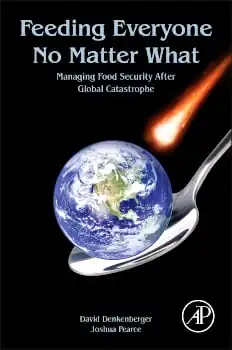
- David Denkenberger and Joshua Pearce, Feeding Everyone No Matter What: Managing Food Security After Global Catastrophe , 1st Edition, Academic Press, 2015
- Free Preview: Google books
- Cover on Academia
- Facebook page
- Resilient foods for preventing global famine: a review of food supply interventions for global catastrophic food shocks including nuclear winter and infrastructure collapse
- Alternative Foods as a Solution to Global Food Supply Catastrophes
- Resilience to global food supply catastrophes
- Feeding Everyone if the Sun is Obscured and Industry is Disabled
- Cost-Effectiveness of Interventions for Alternate Food to Address Agricultural Catastrophes Globally
- Feeding Everyone: Solving the Food Crisis in Event of Global Catastrophes that Kill Crops or Obscure the Sun
- Food without sun: Price and life-saving potential
- Cost-effectiveness of interventions for alternate food in the United States to address agricultural catastrophes
- Micronutrient Availability in Alternative Foods During Agricultural Catastrophes
- Preliminary Automated Determination of Edibility of Alternative Foods: Non-Targeted Screening for Toxins in Red Maple Leaf Concentrate
- Open Source Software Toolchain for Automated Non-Targeted Screening for Toxins in Alternative Foods
- Scaling of greenhouse crop production in low sunlight scenarios
- Potential of microbial protein from hydrogen for preventing mass starvation in catastrophic scenarios
- U.S. Potential of Sustainable Backyard Distributed Animal and Plant Protein Production During & After Pandemics
- Global distribution of forest classes and leaf biomass for use as alternative foods to minimize malnutrition
- Long-term cost-effectiveness of interventions for loss of electricity/industry compared to artificial general intelligence safety
- Long term cost-effectiveness of resilient foods for global catastrophes compared to artificial general intelligence safety
- Rapid repurposing of pulp and paper mills, biorefineries, and breweries for lignocellulosic sugar production in global food catastrophes
- Nutrition in Abrupt Sunlight Reduction Scenarios: Envisioning Feasible Balanced Diets on Resilient Foods
- Methane Single Cell Protein: securing protein supply during global food catastrophes
- Killing two birds with one stone: chemical and biological upcycling of polyethylene terephthalate plastics into food
- How Easy is it to Feed Everyone? Economic Alternatives to Eliminate Human Nutrition Deficits
- Quantifying Alternative Food Potential of Agricultural Residue in Rural Communities of Sub-Saharan Africa
- Yield and Toxin Analysis of Leaf Protein Concentrate from Common North American Coniferous Trees
- Toxic Analysis of Leaf Protein Concentrate Regarding Common Agricultural Residues
- Towards Sustainable Protein Sources: The Thermal and Rheological Properties of Alternative Proteins
- How we can mine asteroids for space food
Additional Information
- ALLFED
- Dave Denkenberger Publications
- OSE Wiki "Synfood" (i.e. protein and other dietary components from microbial organisms fed on gas or other hydrocarbons)